June 10, 2026
Global Risk
Assessment
June 10, 2026 · Comprehensive Edition
The first half of 2026 has compressed a decade of disruption into four months. A direct war between the United States, Israel, and Iran rewrote commercial aviation and maritime insurance across the Middle East. A regime change in Caracas redrew the Western Hemisphere's risk map overnight. And the kidnap economy, from the Sahel to Sinaloa to Southeast Asia, has grown more organized, more transnational, and more deliberate in its targeting of foreign nationals and the affluent families behind them.
What follows is our current assessment across all inhabited continents, backed by live OSINT and government advisory data, with specific implications for protected travel, duty-of-care programs, and family office security.
Prepared for: Principals, Family Offices & Institutional Clients
Date: June 2026
Classification: Public
Coverage: All Inhabited Continents
I · Middle East: The Defining Theater
An active conflict zone with perishable departure windows and degraded consular coverage across sixteen countries
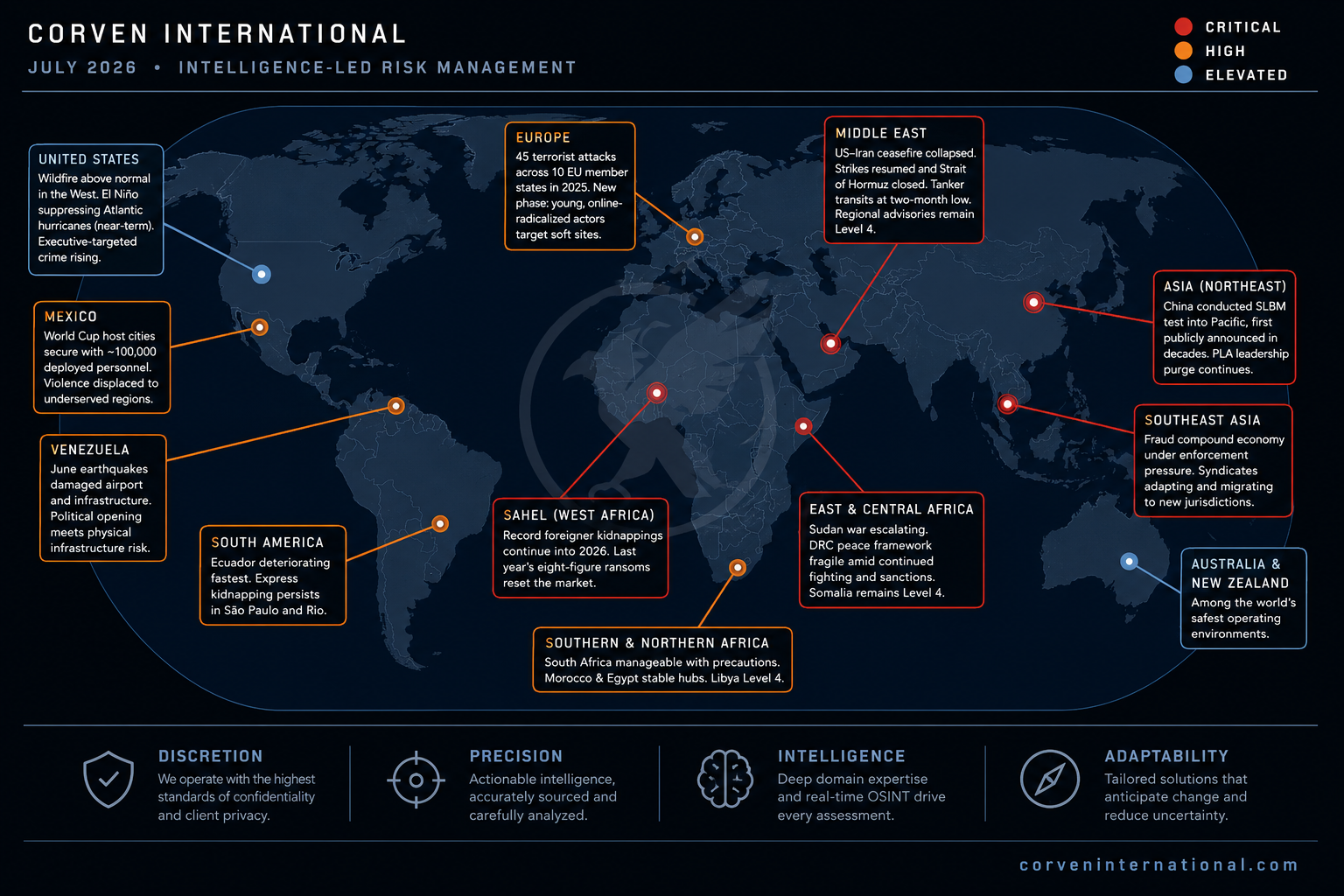
The war between the United States, Israel, and Iran that began February 28, 2026 remains the year's defining geopolitical event. US and Israeli strikes targeted Iranian nuclear facilities and regime leadership. Iran responded with missile and drone attacks across the region and by closing the Strait of Hormuz, triggering one of the most severe global trade disruptions in recent history. A Pakistan-mediated ceasefire took effect April 8, holding roughly eight weeks before fracturing.
As of early June 2026, Israeli strikes have resumed against Iranian positions and continue in Lebanon. A second Israel–Lebanon ceasefire agreed April 16 is also under pressure. Iran has suspended active operations but warned they will resume if Israeli strikes in southern Lebanon continue. The Quds Force has publicly declared intent to establish a "new security belt" from the Strait of Hormuz to the Bab al-Mandab, with direct implications for Red Sea and East Africa maritime corridors.
Aviation & Maritime
Roughly half the airlines that served Israel before the war have not returned. Gulf hubs in Dubai, Doha, and Riyadh remain open but operate under caution advisories, with closures possible on hours' notice. Kuwait International Airport suffered a drone strike and remains partially operational. Strait of Hormuz traffic fell more than ninety percent at the height of the crisis. Marine insurance has been widely withdrawn from regional routes.
Consular & Diplomatic Coverage
US diplomatic posts in Kuwait and Bahrain have suspended services. Non-emergency personnel have departed several Gulf posts. The State Department's advisory urging citizens to depart sixteen regional countries remains the baseline. Stanford University has prohibited institutional travel to or through Israel, Iran, Bahrain, Kuwait, Lebanon, Qatar, Saudi Arabia, Syria, Turkey, and the UAE through at least August 2026, an institutional benchmark reflecting the severity of the environment.
Our assessment: Organizations with personnel in the Gulf should treat commercial departure options as perishable. Oman remains the most reliable corridor in the region. Standing departure criteria, pre-positioned ground transport, and current documentation matter more right now than at any point in recent memory.
II · Europe: Elevated Threat, Strained Alliances
Elevated terrorism footing across the EU, persistent Russian hybrid operations, and a Ukraine war without a peace framework
Europe's security environment in 2026 is under exceptional strain. The EU Institute for Security Studies identifies three top risks: a disruptive hybrid attack on critical infrastructure, Russia's continued aggression against neighboring states, and US withdrawal of security guarantees. The European Commission launched its ProtectEU counter-terrorism agenda in February 2026 in direct response to an elevated jihadist threat amplified by the Iran conflict.
Europol has warned of an elevated terrorism threat linked to Iranian networks and extremist actors capitalizing on regional conflict narratives. France has deployed Opération Sentinelle at its highest footing. Germany has increased security measures at exposed locations. Both governments cite maximum vigilance with no confirmed imminent attack.
Russia–Ukraine: The Managed Stalemate
A 32-hour Orthodox Easter truce in April 2026 and a Trump-brokered three-day ceasefire around Russia's May 9 Victory Day both held nominally while accompanied by mutual violations. No framework for lasting settlement exists. The conflict sustains Russia's hybrid attack posture against Western Europe (cyberattacks, disinformation, and sabotage of undersea cables) as a structural, not episodic, condition.
Our assessment: Western Europe's major capitals remain among the world's safest operating environments, but they are not static. Protected travel should include advance site surveys, accommodation hardening, and real-time monitoring tied to Iran conflict developments. Turkey warrants particular attention as a bridge between European and Middle Eastern threat theaters.
III · The Americas: Proximity Does Not Mean Predictability
A hemisphere split between acute operational hazard in the north and emergent opportunity in the south
Mexico: World Cup Context
Mexico hosts World Cup matches from June 11, drawing extraordinary international visitor volumes into an environment flagged simultaneously by eight governments: the US, Canada, UK, Australia, Germany, France, New Zealand, and Japan. Six states carry Level 4 "Do Not Travel" advisories. The State Department has elevated Mexico to a terrorism risk category following cartel designations.
In February, a military operation killed CJNG leader Nemesio Oseguera Cervantes ("El Mencho"), triggering retaliatory violence that killed more than 70 people, grounded over 200 flights to and from Jalisco, and placed Guadalajara, a World Cup host city, under shelter-in-place guidance. Mexican authorities now report concern that Colombian ex-soldiers with cartel ties are entering the country using World Cup credentials as cover.
Match attendance, sponsor events, hospitality programs, and any executive travel through the World Cup period warrants advance work: vetted ground movement, route planning, counter-surveillance protocols, and real-time monitoring, not improvisation.
Haiti
Haiti remains the hemisphere's most acute crisis. Armed groups control most of the capital and are expanding into the countryside. The transitional government's mandate has lapsed and US embassy operations have been repeatedly disrupted. For organizations with personnel, family ties, or philanthropic projects in-country, the planning assumption must be that no commercial option will exist when it is needed.
Venezuela: A Changed Risk Profile
Following the January 2026 removal of the Maduro government, detained Americans were released, the US embassy in Caracas resumed operations, and the travel advisory eased for the first time in years. The wrongful detention threat that defined the country for a decade has receded. Genuine risk remains in border regions and the interior; the physical environment does not transform as fast as the political one. We expect renewed commercial interest in Venezuelan energy and infrastructure, and with it, demand for sober ground-truth assessment before capital or personnel move in.
South America
Ecuador continues its trajectory as the hemisphere's fastest-deteriorating security environment outside Haiti, with transnational criminal organizations exploiting institutional weakness across Guayaquil and the coast. Colombia presents a complex mosaic: Bogotá and Medellín are workable with appropriate precautions, while kidnapping risk in rural corridors and the Pacific coast has increased following FARC splinter group activity. Brazil maintains elevated advisories in São Paulo and Rio, where express kidnapping against foreign nationals and high-value visitors remains persistent. Argentina carries a higher security risk designation despite its Level 1 advisory classification.
Our assessment: The northern tier of Mexico, Haiti, and Ecuador demands advance work and contingency planning that treats commercial infrastructure as unreliable. The southern tier offers more operating room but requires current ground-truth rather than outdated country-level generalizations.
IV · Africa: The Kidnap Economy Matures
Abduction as an organized business model, expanding from the Sahel toward coastal West Africa and the Great Lakes
West Africa & the Sahel
Militant groups in Mali and Niger drove foreigner kidnappings to record levels in 2025. Both JNIM and ISSP launched deliberate campaigns targeting foreign nationals: JNIM as economic warfare against industrial facilities and mining sites, and ISSP targeting Western nationals specifically and outsourcing abductions to criminal networks. This represents a structural shift toward high-value hostage-taking rather than simple operational disruption.
A new frontline is consolidating along the Benin–Niger–Nigeria borderlands. ACLED records nearly seventy percent more fatalities in Benin in 2025 versus the prior year. In Nigeria, mass abductions prompted a national emergency declaration. US military strikes against the Lakurawa militant group in Sokoto State in December 2025 signal Washington's direct threat assessment. Mali's Defence Minister Sadio Camara was killed in a militant attack in April 2026, a significant indicator of institutional penetration depth. Russia's Africa Corps continues providing logistical and aerial support to the junta, sustaining urban control even as broader security deteriorates.
East & Central Africa
Sudan's civil war continues to produce one of the world's gravest humanitarian crises, sustained by foreign mercenaries and external state backing. Eastern DRC remains volatile; the DRC–M23/Rwanda hostilities and the Rwanda–Burundi dynamic are interconnected threats requiring coordinated regional management. DRC's mineral wealth ensures continued foreign commercial presence in contested areas, a duty-of-care liability that cannot be addressed through standard travel policies. Somalia remains Level 4 "Do Not Travel." Ethiopia–Eritrea tensions continue as a structural Horn risk. South Sudan's fragile peace depends on external guarantors increasingly distracted by other theaters.
Southern & Northern Africa
South Africa's operating environment is manageable with appropriate precautions; crime, particularly vehicle crime and opportunistic violence, is the primary concern. Johannesburg requires route-conscious ground movement. Morocco and Egypt function as relatively stable commercial hubs. Libya remains Level 4. Algeria carries an elevated security risk designation.
Our assessment: For clients with extractive, energy, agricultural, or philanthropic interests across West and Central Africa, the kidnapping threat is no longer incidental. It is the business model of the region's armed groups. Duty-of-care programs must be built accordingly: vetted local networks, journey management, and proof-of-life protocols established before they are needed.
V · Asia & the Pacific: Two Different Kinds of Risk
Macro-strategic contingency at the Taiwan Strait; micro-criminal precision targeting of affluent families across Southeast Asia
Taiwan Strait
Chinese military exercises now routinely rehearse port blockades and have begun disrupting civilian air routes. China launched rockets into Taiwanese waters in December 2025 in a demonstration Taiwan's President Lai Ching-te characterized as both a campaign against international support and a diversion from domestic economic pressures. The probability of open conflict remains low. The cost of being unprepared does not.
For executives who travel regularly to Taipei, Shanghai, or Hong Kong, the practical concerns are exit bans, short-notice airspace disruption, and the speed at which a routine business trip becomes an extended involuntary stay. Increasing Japan–China tensions and China–Philippines friction in the South China Sea add secondary pressure points across the first island chain.
Southeast Asia: The Fraud Compound Economy
Industrial-scale fraud operations in Myanmar, Cambodia, and Laos have extracted more than $10 billion from Americans, with affluent individuals and their families as a primary target through long-cultivation investment schemes. The same criminal networks traffic workers, including US citizens, into the compounds that run these schemes. US sanctions are forcing closures and migration toward South Asia. Recovering a family member drawn into this ecosystem requires intelligence-led work that consular channels alone cannot provide.
South Asia
The IISS Asia-Pacific Security Assessment notes cross-border clashes between India and Pakistan in 2025 as a significant escalation. Pakistan's internal security environment carries Level 3 status with a higher security risk designation, driven by militant activity and border tensions. Afghanistan remains Level 4. For organizations with regional operations, the India–Pakistan dynamic warrants horizon attention as a contingency that could rapidly disrupt aviation and cross-border supply chains.
Oceania
The Pacific typhoon season is forecast to produce fewer but stronger storms, with the Philippines facing greatest exposure between July and September. Australia and New Zealand rank among the world's safest operating environments; Australia maintains a AAA credit rating from all three major agencies, and is actively receiving HNWI capital migration from Hong Kong and Singapore. Papua New Guinea carries significant risk from crime and infrastructure limitations.
Our assessment: Asia presents two distinct risk profiles. The macro-strategic contingency, Taiwan Strait disruption, requires horizon planning and documented exit protocols for any principal with regular operations in the region. The micro-criminal threat requires family-level awareness programs and a clear escalation path if a family member signals contact.
VI · Cross-Cutting Threat: The Digital Threat Surface
Where physical protection now begins, and ends, with digital exposure
For family offices and HNWI principals, the cyber threat has ceased to be a separate category. It is the precursor to physical harm. According to the Family Wealth Report's 2026 Cybersecurity Forum, 43% of family offices globally experienced a cyber incident in the preceding 24 months, rising to 57% for North American offices and 62% for those managing assets exceeding $1 billion.
The attacks targeting family offices in 2025–26 are precision operations built from publicly available information: SEC filings, LinkedIn profiles, geotagged social media, court records, and prior breach data. AI tools now assemble comprehensive family profiles and craft attacks that bypass standard awareness training. Voice cloning can replicate a family member's voice from three seconds of publicly available audio. In one documented case, a family member's Instagram story inadvertently revealed the yacht's name and embedded GPS metadata; within hours that data was in the hands of high-net-worth targeting specialists, and the family learned of the exposure only after a ransom demand arrived.
Our assessment: Digital hygiene is now a component of physical protection. Security architecture must address open-source exposure, multi-generational device management, and the convergence of smart-home and travel technology with physical access control. These are not IT problems. They are protection problems.
VII · United States: The Season Ahead
Wildfire as the domestic story of 2026; a growing pattern of executive-targeted crime in major metros
Wildfire
Wildfire is the domestic story of 2026. An early, hot spring put the national fire system on elevated footing by March. Above-normal fire potential covers the Great Basin and Rockies in early summer, the Northwest and northern California by August, and Southern California in the fall. For families with residences in the wildland-urban interface, the time to review evacuation plans, asset protection, and insurance posture is now, not when the smoke is visible.
Hurricane Season
Forecasters expect a quieter Atlantic hurricane season under a strengthening El Niño, though a single landfall can define a year. The eastern Pacific is forecast to be active, relevant for anyone with property or travel plans on Mexico's Pacific coast.
Executive Targeting
Reports of targeted residential intrusions, vehicle surveillance, and physical confrontations against high-profile executives and their families have increased across major metro areas. The convergence of digital exposure and physical targeting represents a growing category of domestic risk not captured by conventional residential security postures. A leaked itinerary, a property record, or a geotagged family photo can initiate a targeting sequence that culminates domestically as easily as internationally.
Our assessment: Domestic planning in 2026 must account for both seasonal hazards and the structural shift in executive-targeting patterns. Residential advance surveys, secondary residence protocols, and family communication trees should be reviewed before peak wildfire and hurricane seasons arrive.
Closing Assessment: The Through-Line
Across every region, the pattern repeats. Commercial aviation thins out precisely when it is needed most. Consular services contract under pressure. Insurance withdraws from risk rather than absorbing it. And the digital environment generates threat intelligence for adversaries at the scale and speed that outpaces most protection postures.
The principals and families who navigate 2026 well will be the ones who treated commercial systems as conveniences rather than guarantees, who invested in their own redundancy before the moment demanded it, and who understood that the threat to a high-profile family in 2026 begins in a database, not at a perimeter.
Corven International provides intelligence-led protective services and risk management for high-profile individuals, family offices, and institutional clients worldwide.
Discretion. Precision. Intelligence. Adaptability.